

3015 West Davis Street
Dallas, Texas 75211


ASE Certified Excellence
We are a certified ASE facility dedicated to precision automotive repair. Our team combines technical mastery with advanced diagnostic technology to ensure every vehicle receives the highest standard of care. From complex engine repairs to specialized suspension work, we deliver reliable results backed by industry-leading expertise.
Real experiences from our customers in Dallas, Texas!
"The diagnostic precision at JR Automotive is unmatched. My transmission issue was resolved in one visit. Truly professional."
JR is attentive & friendly, right to the point, Beto does great work fast!
Great prices, honest, very professional and goes over and beyond. I will not be going anywhere else.
Nacole Lopez

01
Vehicle Diagnostics
Vehicle diagnostics means reading the car’s computer through the OBD-II port to pull trouble codes and live sensor data, and a shop typically charges $90 to $200 for a diagnostic scan (often credited toward the repair), while free code readings at auto parts stores only give you the code, not the cause, and complex electrical, ADAS, or hybrid/EV diagnostics can run $150 to $400 or more. A code like P0301 (cylinder 1 misfire) points to where the problem shows up, not what is broken, so a good technician confirms the cause with tests such as checking spark, fuel pressure, compression, or wiring before replacing parts, which helps you avoid paying for a guess. Don’t ignore a check engine light, treat a flashing one as an emergency (it usually means a misfire that can damage the catalytic converter), ask for the codes and the technician’s findings in writing, and consider buying an inexpensive Bluetooth OBD-II reader ($20 to $60) to read codes yourself and sanity-check any quote.

02
Auto Body Shop
Auto body shops handle collision and cosmetic repairs like dent removal ($75 to $500 for paintless dent repair, more for panel work), bumper repair or replacement ($300 to $1,500), scratch and paint touch-ups ($150 to $1,000 per panel), and frame straightening or major collision work ($1,000 to $10,000 or more), with a full repaint running $3,000 to $10,000 and newer cars with sensors, cameras, or aluminum panels costing more because bumpers and mirrors often need recalibration. Get at least two or three written estimates, ask whether parts are OEM, aftermarket, or used, confirm that paint is color-matched and blended into adjacent panels, and check for certifications such as I-CAR or manufacturer approval, especially for newer vehicles with advanced safety systems. If insurance is involved, you have the right to choose your own shop rather than the insurer’s preferred one, so ask for a written warranty on workmanship and paint (many shops offer a lifetime warranty) and request photos of the damage and the finished repair for your records.

03
Engine Repair and Replacement
Engine repair covers fixing specific problems like a head gasket ($1,200 to $3,000), timing belt or chain ($500 to $1,800), valve cover or oil pan gasket leaks ($150 to $600), sensors, coils, or a water pump ($200 to $900), or a top-end rebuild with new valves, rings, or bearings ($2,500 to $5,000), while replacement with a used engine ($2,500 to $5,000 installed), a remanufactured engine ($4,000 to $8,000), or a new crate engine ($5,000 to $10,000 or more) costs more, with diesel, turbocharged, and luxury engines at the high end. Warning signs include knocking or ticking noises, blue, white, or black exhaust smoke, overheating, oil or coolant leaks, milky oil, a flashing check engine light, loss of power, and rapidly dropping oil levels, and catching these early often keeps the fix to a gasket, sensor, or cooling repair instead of a rebuild. Change oil on schedule, keep the cooling system serviced, stop driving immediately if the engine overheats or the oil light comes on, and compare the repair quote to the vehicle’s value, since a remanufactured engine with a solid warranty is often the best choice when the car is otherwise in good shape.

04
Transmission Repair and Replacement
Transmission repair covers fixing specific problems like a fluid and filter service ($150 to $400), a leaking pan gasket or seal ($150 to $500), a faulty solenoid, sensor, or valve body ($250 to $1,200), or a torque converter replacement ($600 to $1,500), while a rebuild runs $2,000 to $4,500 and a full replacement with a new, remanufactured, or used unit costs $3,500 to $8,000 or more, with CVTs, dual-clutch units, and hybrid or luxury transmissions at the high end. Warning signs include slipping gears, delayed or harsh shifts, a burning smell, whining or clunking noises, a check engine light, and red or brown fluid leaking under the car, and catching these early often keeps the fix to a fluid service or a sensor instead of a rebuild. Check the fluid level and condition per your owner’s manual, change it at the recommended interval (commonly 30,000 to 60,000 miles for automatics, sooner if you tow), and get a second opinion before approving a rebuild or replacement, since a remanufactured unit with a solid warranty is often the best value over the long run.

05
Break System Repair and Replacement
Brake system repair usually means replacing worn wear items, with pads running $150 to $300 per axle, pads plus resurfaced or new rotors $300 to $800 per axle, a caliper $200 to $600 each, and a brake fluid flush $80 to $150, while replacement of larger components like a master cylinder ($300 to $800), brake lines or hoses ($150 to $500), or an ABS module ($500 to $1,500 or more) costs more and is often tied to leaks, corrosion, or electronic faults. Warning signs include squealing or grinding, a soft or spongy pedal, the car pulling to one side when braking, vibration through the pedal or steering wheel, a brake warning or ABS light, and fluid that looks dark or is leaking, and since grinding means the pads are gone and the rotors are being damaged, acting early usually keeps the job to pads alone. Replace pads and rotors in axle pairs, flush the fluid about every 2 to 3 years because it absorbs moisture, and don’t delay any repair when the pedal feels soft or the car takes longer to stop, since brakes are a safety system and should be inspected by a qualified shop right away.

06
Auto Tune-Up
A tune-up today usually means a preventive maintenance visit rather than the old carburetor adjustment, typically covering spark plugs ($100 to $400 depending on engine type and whether it has 4, 6, or 8 cylinders), air and cabin filters ($40 to $120), fuel filter or fuel system cleaning ($100 to $250), and an oil change plus fluid and belt/hose inspection, with a basic tune-up running about $200 to $800 and more for coil packs, spark plug wires, or a throttle body cleaning. Signs you’re due include rough idling, hard starting, hesitation or misfires, worse gas mileage, a check engine light, or reaching the mileage interval in your owner’s manual, which for modern cars is often 60,000 to 100,000 miles for spark plugs, with air filters every 15,000 to 30,000 miles. Follow the manufacturer’s maintenance schedule instead of a generic package, use the plug type your engine specifies (iridium and platinum cost more but last longer), and ask the shop for an itemized quote so you only pay for work your car actually needs.
07
A/C Replacement and Repair
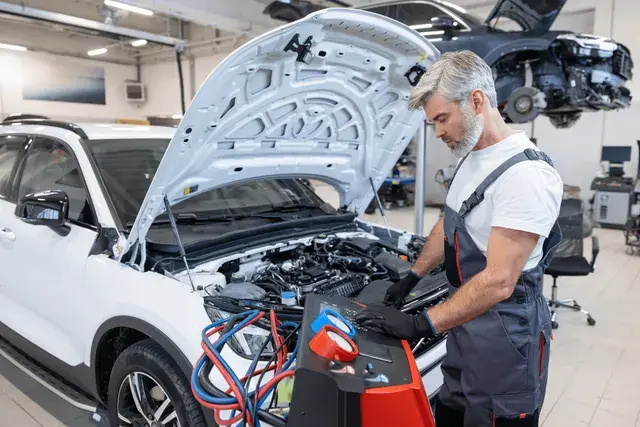
A/C repair covers fixing specific faults like a refrigerant leak and recharge ($150 to $500), a bad relay, fan, or pressure switch ($100 to $400), or a failed compressor clutch or blower motor ($300 to $800), while replacement of major components runs higher, with a new compressor ($800 to $1,800), condenser or evaporator ($500 to $2,000, since the evaporator often means removing the dash), and a full system overhaul reaching $2,500 or more on newer vehicles. Warning signs include air that blows warm or weakly, a musty smell, hissing or clicking noises, water pooling inside the cabin, or the system cycling on and off, and a simple leak check and recharge early on can prevent a failing part from sending debris through the whole system and forcing a costly full replacement. Have a certified technician handle refrigerant (required by law in the U.S.), ask whether the system uses R-134a or the newer R-1234yf, which costs noticeably more, and when a compressor fails, also replace the receiver/drier or accumulator and flush the system so the new part isn’t damaged by contamination.

08
Windshield Replacement
A windshield replacement typically takes 1 to 2 hours, costs roughly $250 to $500 for a basic setup (more, up to $1,500 or higher, for cars with rain sensors, heads-up displays, or driver-assist cameras), and requires a safe drive-away wait of 30 minutes to a few hours while the adhesive cures. If your car has lane-keeping or automatic braking, the forward camera usually needs recalibration afterward, which can add $150 to $400 and is an important safety step. Glass is generally covered under comprehensive insurance subject to your deductible, so get quotes from two or three shops and ask about glass type (OEM or aftermarket), adhesive, and a workmanship warranty.

09
Electrical Repair and Replacement
Electrical repair fixes specific faults like a dead outlet, a tripping breaker, flickering lights, or a bad switch, and usually costs $150 to $500 for a single fix, while replacement covers larger upgrades such as a breaker panel ($1,500 to $4,000), old wiring, or knob-and-tube and aluminum wiring ($3,000 to $15,000 or more for a whole house). Repair is usually enough when the problem is isolated, but replacement makes sense when wiring is outdated, panels are overloaded or from a known problem brand, or you see burning smells, scorch marks, or frequent breaker trips that signal a wider hazard. Always hire a licensed electrician, since most jurisdictions require permits and inspections for panel and wiring work, and get two or three written quotes before committing.

10
Suspension Repair and Replacement
Suspension repair addresses individual worn parts such as shocks or struts ($250 to $1,000 per axle), control arms, bushings, ball joints, or sway bar links ($150 to $600 each), while replacement of an entire assembly, like complete strut units, coil springs, or air suspension components, can run $1,000 to $3,000 or more, with air suspension and electronically controlled systems at the high end. Repair is usually enough when only one or two parts are worn, but replace in pairs (both sides of an axle) when swapping shocks, struts, or springs, and consider full replacement if you notice a bouncy or nose-diving ride, clunking over bumps, uneven tire wear, or the car pulling to one side. Get an alignment after any major suspension work, and have a trusted shop inspect the car before you commit, since worn suspension affects braking distance and handling and should not be put off.

11
Rear Repair Differential
Rear differential repair usually means replacing worn parts like seals, bearings, or the fluid ($150 to $600 for a leaking pinion or axle seal, a fluid change, or a bearing job), while major work such as rebuilding the gears and carrier, or replacing the whole unit, typically runs $1,000 to $3,500 or more depending on the vehicle, with a used or remanufactured unit often cheaper than new. Warning signs include whining or howling that changes with speed, clunking or clicking when turning or shifting between drive and reverse, vibration, gear oil leaking at the pinion or axle seals, and burnt-smelling or metal-filled fluid, and catching these early often keeps the fix to a seal, bearing, or fluid service instead of a full rebuild. Change the gear oil at the interval in your owner’s manual (commonly every 30,000 to 60,000 miles, sooner if you tow), use the correct fluid type and any required friction modifier for limited-slip units, and replace gears and bearings as a set so the gear pattern and preload are set correctly, ideally by a shop experienced with differential setup.

12
Door Glasses, Window Regulator and Door Handle Replacement
Door glass, window regulator, and door handle replacement are common repairs that often overlap, since the regulator and glass both live inside the door panel. Door glass runs about $200 to $500 per door (more for laminated, tinted, or acoustic glass), a window regulator and motor runs $200 to $500 installed (the part is $50 to $200, and the rest is labor to remove the door panel), and a door handle costs $100 to $400 for an exterior handle or $80 to $250 for an interior one, with newer cars that have keyless entry sensors or flush electronic handles at the high end. Signs you need work include a window that drops into the door, moves slowly, or makes grinding or clicking noises (regulator or motor), a handle that feels loose, limp, or won’t open the door (broken cable or clip), or a cracked or shattered pane, and since the repairs share the same labor, it saves money to fix them together while the panel is already off. Ask whether parts are OEM or aftermarket, confirm that any wiring, wind-noise seals, and power-window calibration are included, and get a written quote, because a door that won’t lock or a window that won’t close is also a security and weather issue worth fixing soon.

13
Tire Replacement, Rotation, Balance and Alignment
Tire replacement runs about $100 to $350 per tire for most passenger cars (more for trucks, performance, or run-flat tires), with mounting, balancing, new valve stems, and disposal adding $15 to $50 per tire, while rotation costs $25 to $50 (often free with tire purchase), balancing $15 to $30 per tire, and a four-wheel alignment $90 to $200. Rotate every 5,000 to 7,500 miles to even out wear, balance whenever you get new tires or feel vibration at highway speed, and get an alignment after new tires, suspension work, or a curb hit, or if the car pulls to one side or shows uneven tire wear. Replace tires at 2/32 inch of tread (the penny test: if you can see all of Lincoln’s head, it’s time), or sooner if you see cracks, bulges, or tires older than about six years, and when replacing, ideally swap all four or at least both on an axle, check the tire pressure monthly, and ask about road hazard and treadwear warranties before you buy.


Our Commitment
We treat every vehicle as if it were our own. We'll explain what we find in plain language, walk you through your options, and get you back on the road comfortable and confident.
We use certified refrigerant recovery equipment, follow proper procedures, and test every system before it leaves our shop.
For more than two decades, Dallas drivers have trusted JR Automotive. We're proud of that trust, and we work to earn it every day.
JR Automotive: Proudly serving Dallas since 2003.